
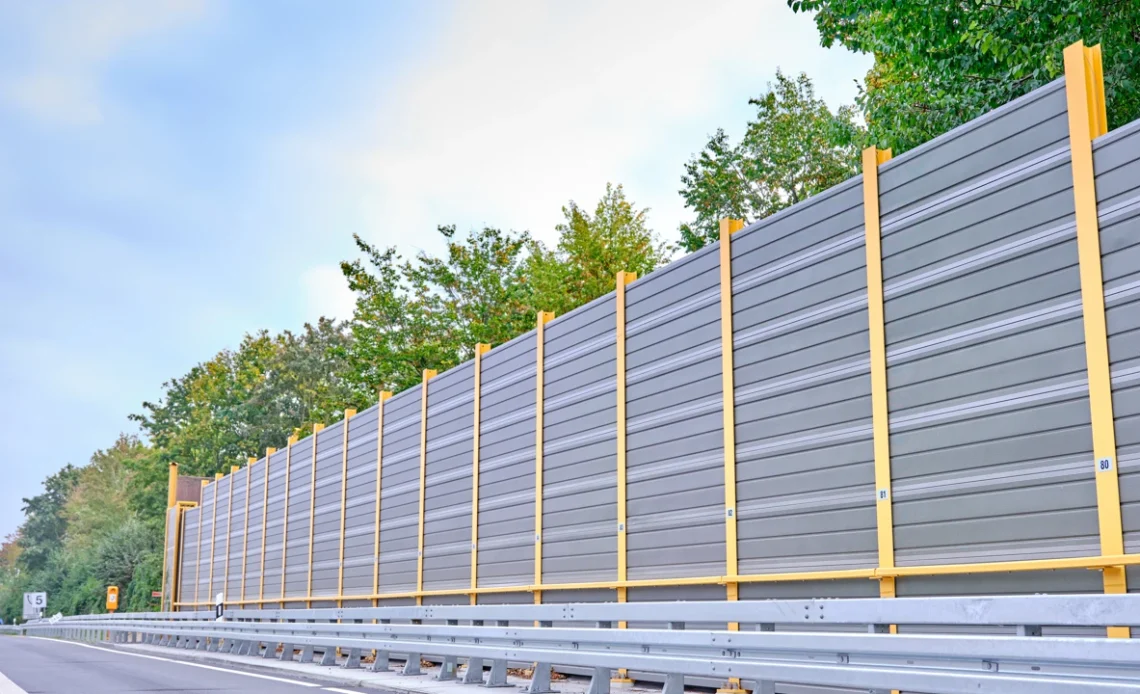
When people think about controlling noise on a busy site, the first thing that usually comes to mind is barriers. Put up a wall, block the sound, job done. In reality, it rarely works out that neatly. Construction sites, industrial yards, and even temporary event setups are far more complicated than that. Sound doesn’t just travel in a straight line and politely stop when it meets a fence. It bends, bounces, travels through structures, and often finds the weakest point to escape.
That’s why relying on barriers alone can leave you disappointed. They are useful, but they are only one piece of a much bigger picture. Once you understand how noise actually behaves on site, it becomes clear why a broader approach is needed and why different noise reduction methods often need to work together rather than in isolation.
Why barriers eventually reach their limit.
Noise barriers are designed to block direct sound paths. If a generator is on one side and a residential building is on the other, a properly placed barrier can noticeably reduce what people hear. The issue is that most sites are not that simple.
Sound doesn’t only travel forward. It goes over the top of barriers, leaks through gaps, and reflects off nearby hard surfaces like concrete walls or metal containers. On larger sites, multiple noise sources interact, creating a constant background level that a single barrier cannot handle.
There is also the problem of height. A barrier that is too low will do very little, and raising it is not always practical due to cost, wind loading, or space constraints. So while barriers are a helpful starting point, they are rarely the complete answer.
Thinking beyond a single solution.
Once barriers stop being enough, it helps to shift the mindset slightly. Instead of asking “what can block the noise?”, the better question becomes “where is the noise coming from and how is it travelling?”
That is where more layered thinking comes in. Effective control is usually a combination of different strategies working together, rather than one big fix.
This is where proper noise control options start to matter, especially on complex or long-running sites where conditions change daily.
Tackling noise at the source.
The most effective way to reduce noise is often the simplest in concept, even if it is not always the easiest to implement. If you can reduce noise where it is created, everything else becomes easier.
On construction sites, this might involve choosing quieter machinery or upgrading older equipment that has become noisier with age. Regular maintenance also plays a surprisingly big role. Loose panels, worn parts, and poorly serviced engines tend to generate far more noise than well-maintained ones.
In some cases, adding mufflers or acoustic covers to specific machines can make a noticeable difference. Even repositioning equipment so that exhausts or loud components face away from sensitive areas can help reduce the overall impact.
It might not feel as dramatic as putting up a large barrier, but source control often delivers the biggest long-term improvement.
Dealing with vibration, not just sound.
One of the most overlooked issues on site is vibration. People tend to focus on airborne noise, but a lot of what we hear and feel actually comes through structures.
Heavy machinery, compressors, and generators can transfer vibration into the ground or building frames. Once that happens, sound can travel much further than expected, sometimes reappearing in places that seem completely disconnected from the original source.
If vibration is not addressed, even the best barriers will struggle to make a meaningful difference.
Simple solutions like rubber mounts, anti-vibration pads, or isolation frames can significantly reduce how much energy is transferred. On more demanding sites, engineered isolation systems might be required, especially where sensitive buildings or residential areas are nearby.
Rethinking layout and positioning.
Sometimes the most effective changes do not involve new materials at all. They involve repositioning.
Moving noisy equipment further away from sensitive boundaries can reduce perceived noise levels more than expected. Sound loses energy over distance, so even a small shift in layout can help.
Grouping noisy activities into a single zone is another practical approach. Instead of spreading sound across the entire site, it becomes more contained and predictable. That makes it easier to manage and shield.
Timing also plays a role. Scheduling the loudest activities during less sensitive hours can reduce complaints and improve overall site relationships with nearby communities.
Using absorption instead of only blocking.
Hard surfaces reflect sound. On many sites, this creates a problem where noise bounces around and becomes trapped, especially in enclosed or semi-enclosed spaces like courtyards or container yards.
This is where absorptive materials come in. Unlike barriers that simply block sound, absorptive surfaces help reduce echo and reverberation by soaking up part of the sound energy.
Acoustic panels, lined hoardings, and treated enclosures can all help reduce the overall noise build-up. The effect is not just about what leaves the site, but also about how loud the site feels internally for workers and operators.
A quieter working environment can also improve communication, safety, and concentration, which are often overlooked benefits.
When simple solutions are not enough on their own.
On smaller or straightforward sites, one or two methods might be enough. On larger or more complex projects, it rarely works that way. Noise behaves too unpredictably, and conditions change too often.
That is why the most reliable approach is layered. Source reduction, vibration control, smart layout planning, and acoustic treatment all work together to create a more stable outcome.
In other words, real-world mitigation is less about finding a single fix and more about building a system that handles noise from multiple angles at once.
Bringing It All Together
Once you start looking at noise as a system rather than a single problem, everything changes. Barriers still have their place, but they become part of a wider toolkit rather than the main solution.
This is where practical experience matters. Knowing when to rely on physical shielding, when to adjust equipment, and when to rethink layout can make a significant difference to both compliance and day-to-day site conditions.
At that point, you are no longer just reacting to complaints or regulations. You are actively shaping how sound behaves on site.
That is the real value of combining approaches rather than depending on a single fix, and it is what makes modern construction and industrial environments far more manageable when properly planned.