
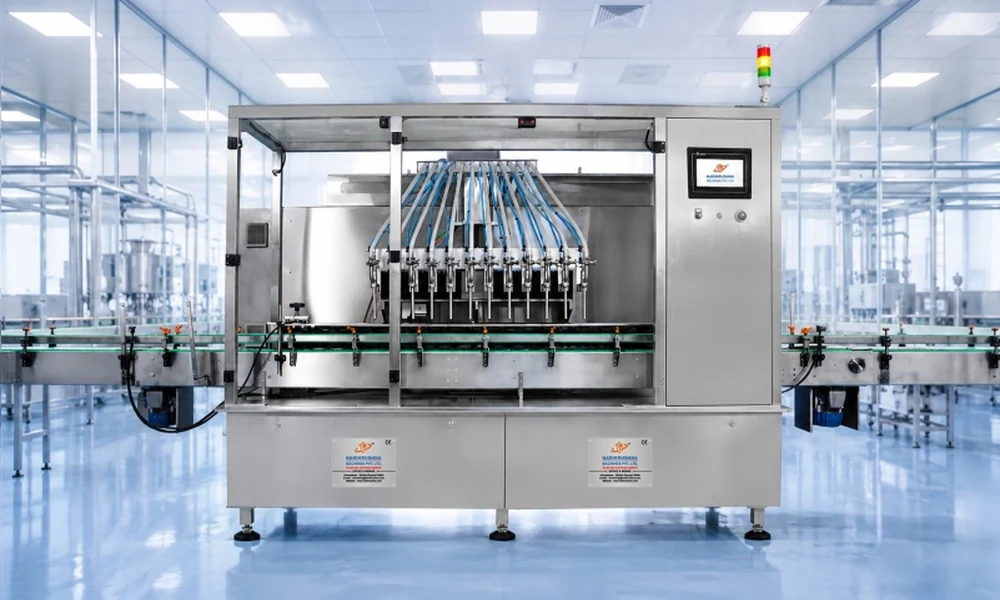
An automatic liquid filling machine in Singapore is a production line investment that transforms the economics of liquid packaging. Manual filling operations are inherently limited in throughput by human operator speed, are prone to variability in fill volumes, and create ergonomic demands that generate fatigue and error over extended shifts. A correctly specified automatic filling machine resolves all of these limitations simultaneously, producing consistent, measured fills at throughput rates that manual operations cannot approach.
How Automatic Liquid Filling Works
Automatic liquid filling machines use a range of filling principles, each suited to different liquid types and packaging formats.
Volumetric filling dispenses a precisely measured volume of liquid for each fill cycle. The measuring mechanism may be a piston that displaces a fixed volume, a flow meter that measures the volume passing through it, or a timed pump that delivers a consistent flow rate for a fixed duration. Volumetric filling is suitable for free-flowing liquids where volume is the appropriate measure of fill accuracy.
Gravimetric or weight-based filling uses load cells to measure the weight of liquid dispensed rather than its volume. This approach is preferred for products where density variation means that volume-based filling would produce weight inconsistencies, and for high-value products where accuracy at the gram level is required.
Level filling fills containers to a consistent visible level rather than a consistent volume or weight. This is used where the visual fill level is the consumer-facing quality indicator, even if some weight variation between containers is acceptable.
Overflow filling is used for low-viscosity liquids in clear containers where a consistent overflow level appearance is important for the retail presentation.
High Viscosity Applications
Automatic liquid filling machines in Singapore for high-viscosity products – thick sauces, adhesives, lubricants, pastes, creams, and gels – require specific design adaptations relative to machines intended for thin, free-flowing liquids.
High-viscosity products resist flow under gravity and require positive pressure or mechanical assistance to move through the filling system consistently. Positive displacement pumps, including gear pumps, peristaltic pumps, and rotary lobe pumps, provide the controlled, positive-pressure product transfer needed for these applications without the product settling or bridging in the feed system.
The dispensing nozzle design for high-viscosity products must minimise drip and stringing after the fill cycle ends. Nozzles with shut-off mechanisms, anti-drip features, and in some cases heated nozzles that maintain product fluidity at the point of dispense are standard for high-viscosity applications.
Speed and Efficiency Gains
The efficiency gains from automatic liquid filling systems are substantial and quantifiable. A single automatic filling machine can typically produce 10 to 40 fills per minute depending on container size and product type. A comparable manual filling operation might produce 3 to 8 fills per minute at best, with more variability in fill accuracy.
Over an 8-hour production shift, this throughput difference represents a multiplication of output that rapidly justifies the capital investment in automatic equipment. The fill accuracy improvement reduces product give-away, which in high-value product categories has direct financial impact.
As Singapore’s Economic Development Board has noted in guidance on manufacturing productivity, “Automation of repetitive manual production tasks delivers compound benefits: higher throughput, consistent quality, and reduced dependence on labour that is both increasingly expensive and difficult to source in Singapore’s tight labour market.”
Integration with Production Lines
Automatic liquid filling machines in Singapore manufacturing operations are typically integrated into broader production lines that include container feeding systems, filling, capping, labelling, and end-of-line packaging. Smooth integration between these stations requires coordination of conveyor speeds, container handling mechanisms, and control system communication.
Modern automatic filling machines offer programmable recipe control that allows different products and container sizes to be set up by selecting a stored recipe rather than manually readjusting all machine parameters. This changeover flexibility is important for manufacturers running multiple SKUs through a shared filling line.
Choosing the Right Filling Machine
The correct automatic liquid filling machine specification for Singapore production operations depends on product viscosity and flow characteristics, target fill weight or volume accuracy, container type and size range, required production throughput, and the degree of line integration planned. A specialist supplier with experience across different filling technologies and application types provides the most reliable guidance on which machine design will perform correctly in a specific application.