
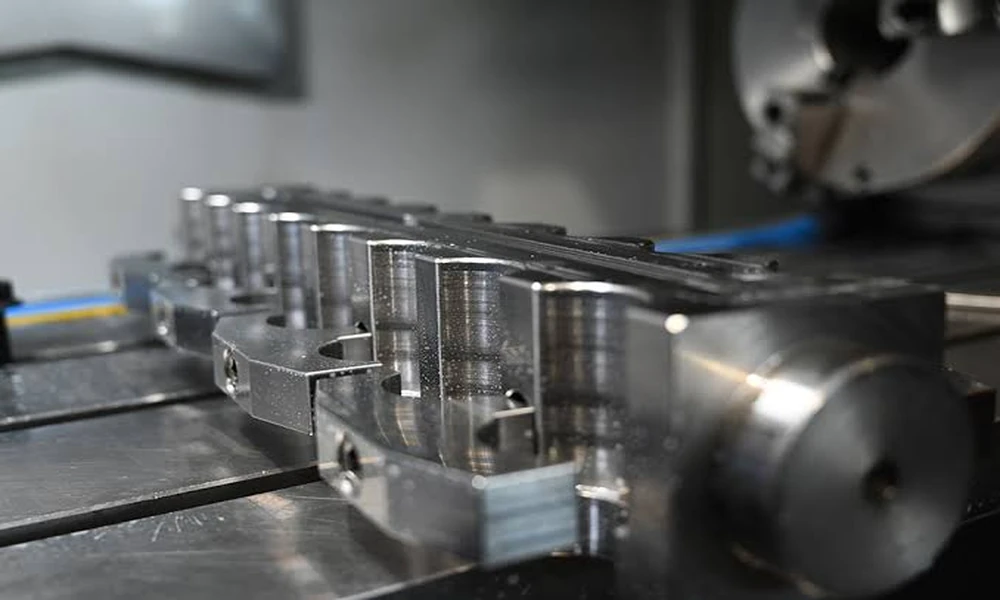
Selecting the right materials for CNC turning in Brisbane, QLD is all about balancing machinability, strength, and local compliance. CNC machine shops in Australia work within the Australian Standards (AS/NZS) alongside international equivalents to ensure every turned component performs reliably. These criteria apply to all applications, including heavy-duty mining shafts and medical fittings.
Understanding Australian Bar Stock Standards
Specifying the wrong supply condition on an engineering drawing can potentially inflate machining costs or delay procurement. Australian workshops primarily rely on three core standards when sourcing metal bar stock:
- AS 1442 & AS 1443 (Carbon & Free-Cutting Steels) – AS 1442 covers hot-rolled “black” bar, which is ideal when large outer diameters will be completely turned away. AS 1443 governs bright (cold-drawn or ground) bar, offering tight dimensional accuracy and a clean surface finish that feeds smoothly through CNC lathe collets.
- AS 1444 (Wrought Alloy Steels) – This standard regulates high-tensile steels like 4140, using suffix letters, such as -S or -U, to define specific tensile strength conditions.
- AS 1100 & ISO 2768 (Drawings & Tolerances) – While AS 1100 sets the rules for Australian technical drawings, local CNC machinists universally default to ISO 2768-m for general linear tolerances unless tighter callouts are specified.
Popular CNC Turning Materials in Australia
Choosing a grade tailored for lathe operations reduces cycle times, extends tool life, and prevents stringy chips from tangling around your workpiece. Below is a simple guide detailing each material:
- Free-Machining Steels (AS 1443 1214 / S1214) – Resulfurised for rapid chip breakage, 1214 is the go-to choice for high-volume pins, bushes, and fasteners. It is important to know that welding this grade is dangerous, as sulfur causes hot cracking.
- Medium & High-Tensile Steels (1045 & 4140) – Bright 1045 delivers solid strength for axles and hydraulic rams, while pre-hardened 4140 handles extreme wear in Australian mining and agricultural machinery.
- Stainless Steels (303 & 316) – Grade 303 machines effortlessly for general fittings, whereas marine-grade 316 offers superior corrosion resistance for food processing and coastal environments. However, this grade requires sturdy setups to prevent work-hardening.
- Aluminium & Brass (6061-T6, 2011-T3 & C385) – Aluminium 2011 and free-machining brass C385 allow high spindle speeds and mirror-like finishes, while 6061-T6 provides excellent structural strength and anodising capability.
Precision Turned Parts Backed by RAHI Engineering
If you are looking for a reliable and trusted machinist in Australia, look no further than RAHI Engineering. Established in 1984, RAHI Engineering has provided elite-tier CNC Machining and Repetition Engineering services for various industries in Australia.
Contact us today or complete our online form to request a quote.