
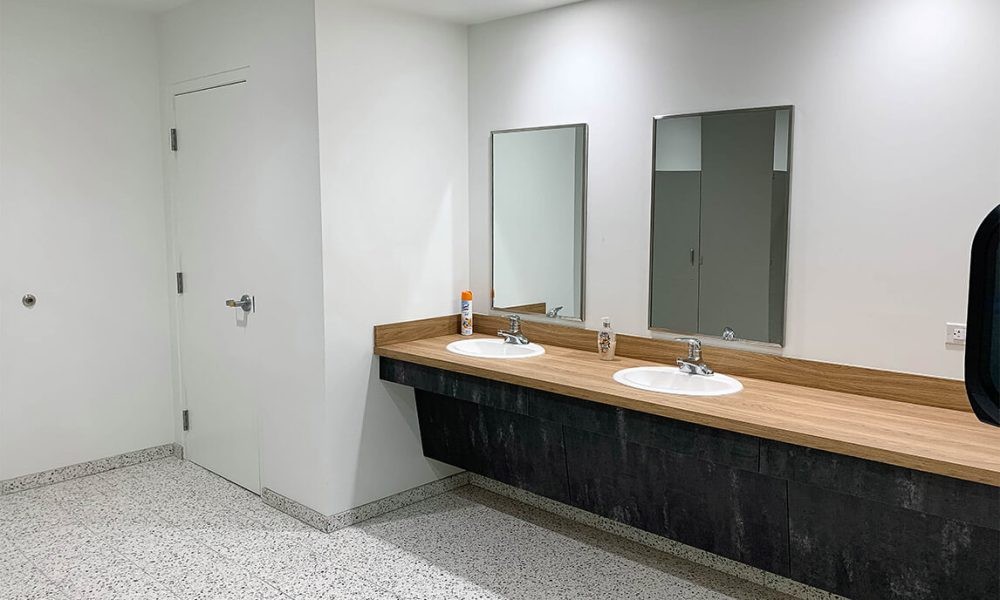
Industrial facility restrooms, serving manufacturing plants, distribution centers, chemical processing facilities, and heavy equipment maintenance operations, present environmental and usage conditions that require partition specifications substantially above those appropriate for commercial office environments.
The worker populations of industrial facilities bring contamination from production environments into restrooms on work clothing, equipment, and skin. Chemical contamination, metallic dust, oil and lubricant residue, and in some facilities, the chemicals of the production process itself are introduced into restroom environments through normal facility use.
What Chemical Resistance Requirements Apply to Industrial Restroom Partitions
Industrial facility restroom cleaning may involve solvent-based degreasers, acid cleaners for mineral deposit removal, and in chemical process facilities, neutralization rinses for specific process chemical contamination. Partition materials and hardware that are not chemically resistant to these cleaning agents show accelerated degradation that generates premature replacement events.
Phenolic solid core panels and solid HDPE partitions provide the broadest chemical resistance across industrial cleaning agent categories. Powder-coated steel and plastic laminate panels are vulnerable to solvent-based cleaners that remove or attack surface coatings, creating corrosion initiation sites at exposed substrate areas.
How Heavy Worker Traffic Affects Hardware Durability Requirements
Industrial worker populations using restroom facilities in work clothing and safety gear, including steel-toed boots and tool belts, generate physical impact forces on partition hardware that substantially exceed those of commercial office or light industrial populations. Specifying commercial partition manufacturer with heavy-duty hardware ratings and documented impact resistance testing appropriate for industrial applications reduces the hardware failure rates that generate the majority of reactive maintenance events in industrial restroom facilities.
What Hygiene Requirements Apply in Food Processing and Pharmaceutical Facilities
Food processing and pharmaceutical manufacturing restrooms are subject to hygiene requirements specified by FDA, USDA, and in some facilities, NSF certification frameworks that go beyond standard commercial sanitation standards. Non-porous surfaces, absence of horizontal surfaces that collect contamination, and drainable configurations that eliminate standing water are required features in these environments.
How Shift-Change Usage Patterns Create Peak Load Conditions
Industrial facilities operating multiple shifts concentrate restroom usage at shift change periods, creating short-duration peak loads that require fixture and partition specifications appropriate for high-intensity use rather than the continuous occupancy patterns of commercial office facilities.
Industrial facility restroom partition specifications must address chemical resistance, physical durability under heavy-use conditions, and in some sectors, hygiene standards that go well beyond commercial specification norms. The consequences of under-specifying in industrial environments are both financial, from premature replacement events, and operational, from facility downtime and worker safety implications of deteriorated restroom conditions.