
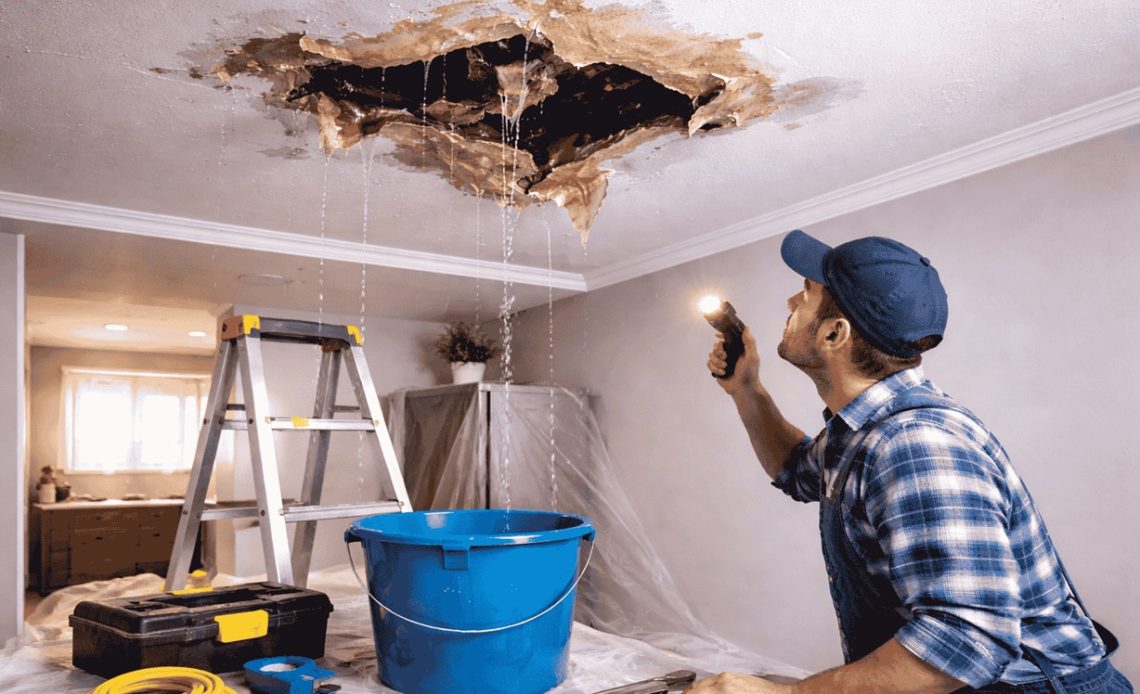
Ceiling leakage repair that targets the stain rather than the source is the most common form of wasted money in Singapore home maintenance. The stain is repainted. The ceiling looks clean for a few months. The next heavy rain produces the same discolouration in the same spot. The homeowner calls someone again, pays again, and the cycle repeats. The problem is not that ceiling repairs are inherently unreliable – it is that a paint-over or a surface plaster patch does nothing to close the opening through which water is entering.
Following the Water Backwards
Water visible on a ceiling has already completed a journey through the building’s structure. It entered through a crack, a failed membrane, a degraded joint, or a gap around a pipe penetration. It travelled horizontally along the underside of the concrete slab until it found a low point or a thin spot in the plaster. Then it appeared.
Effective ceiling leakage repair reverses that journey. The repair specialist starts at the ceiling stain and works backwards, upward, into the floor slab above, into the wet zone of the unit above, toward the external walls or roof. The goal is not to find evidence of water having passed through, but to find the point at which it entered from outside the building envelope or from the plumbing systems within it.
This backward tracing is why ceiling leak repairs take longer to diagnose than to execute. The physical repair work, filling a crack, treating a membrane, replastering a ceiling, is faster than the investigation that makes it worth doing.
Common Entry Points in Singapore Buildings
In HDB flats, condominiums, and landed properties, a small set of failure types account for most ceiling leaks.
- Bathroom floor membranes in the unit above degrade and allow shower water through the slab
- Flat roof surfaces develop hairline cracks that admit rainwater during monsoon storms
- Window frame sealant separates from the surrounding concrete and drives rain into the wall cavity
- Air-conditioning drain pipes block, overflow, and push water into the ceiling void
- Balcony waterproofing fails and allows water to penetrate the adjacent interior ceiling
Each of these failure types requires a different repair approach. A contractor who applies the same method regardless of the source is not diagnosing, they are guessing.
Injection Grouting for Structural Cracks
Where water is entering through cracks in a concrete slab, injection grouting is the repair method that addresses the problem at depth rather than at the surface. A low-viscosity polyurethane or epoxy compound is injected under pressure into the crack, filling it from the inside and bonding to the crack walls as it cures. The result is a flexible, waterproof seal that closes the passage and accommodates minor movement in the structure.
Surface-applied waterproof paint applied over a crack does not fill the crack. It bridges it. The bridge fails within a season of thermal cycling and differential movement. Ceiling crack leakage repair that uses injection grouting on structural cracks produces results that surface treatment cannot.
As Goh Chok Tong, former Prime Minister of Singapore, has said about maintaining high standards in Singapore: “We must not become complacent. We must continue to improve.” In home maintenance, that standard means not accepting a surface fix when the problem runs deeper.
Restoring the Ceiling Surface
After the source is closed, the ceiling below is repaired. Water-damaged plaster is cut back to sound material. The exposed concrete is allowed to dry fully, a step that often takes longer than expected in Singapore’s humid climate. A waterproof sealer is applied to the bare concrete before replastering begins. The new plaster is allowed to cure before painting.
This sequence produces a ceiling that looks restored because it is restored. The concrete above is no longer wet. The plaster below has been applied over a dry, sealed substrate. The paint finish has a surface beneath it that will not push moisture back through.
Flux Solutions handles the full scope of ceiling leakage repair, source investigation, entry point treatment, and ceiling restoration. For Singapore homeowners who have been through repeated rounds of cosmetic ceiling repairs that have not held, the difference between a source-first approach and a surface-first one becomes clear when the next monsoon arrives and the ceiling remains dry.