
Accounts payable used to be treated as a back-office chore – receive an invoice, get it approved, cut a cheque. But for any company operating across multiple entities, vendors, currencies, and tax jurisdictions, AP has quietly become one of the most complex and high-risk functions in finance. A single missed invoice can put a critical vendor relationship on hold. A duplicate payment can leak thousands of rupees before anyone notices. A delayed approval can mean losing an early-payment discount that was sitting right there.
This is exactly why accounts payable services have moved from a “nice to have” to a strategic priority for CFOs and finance leaders in 2026. Whether a business chooses to build the function in-house, invest in automation software, or hand the entire invoice-to-pay cycle to a specialist partner, the goal is the same: fewer errors, faster processing, and a payables function that supports the business instead of slowing it down.
What Do Accounts Payable Services Actually Cover?
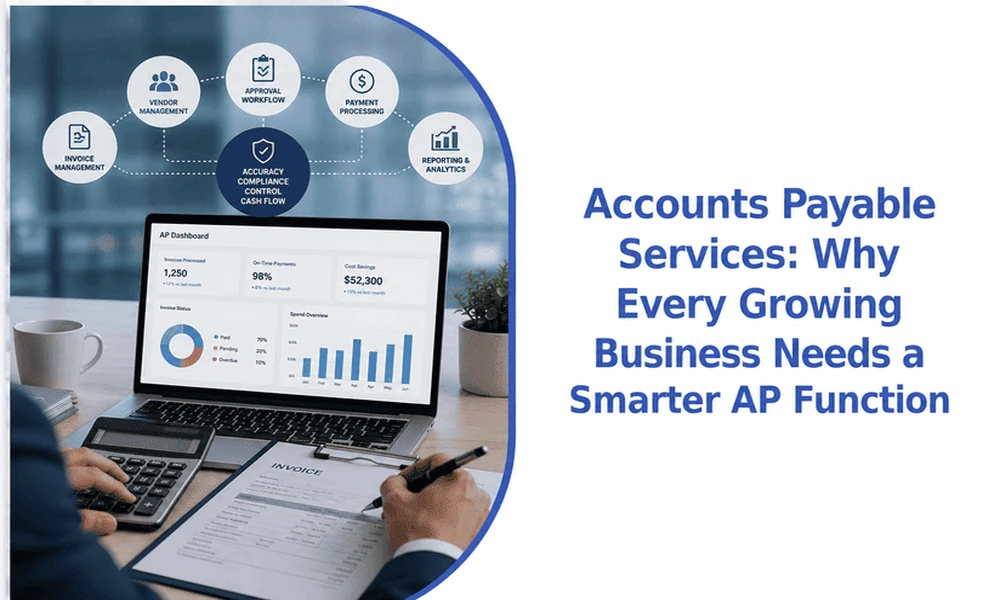
At their core, accounts payable services span the full journey an invoice takes – from the moment it lands in an inbox to the moment payment is confirmed and reconciled in the books. That includes:
- Invoice receipt and data capture
- Three-way matching against purchase orders and goods receipt notes
- Approval routing based on delegation of authority
- Statutory compliance checks (GST input credit, TDS, e-invoicing, e-way bills)
- Payment processing and vendor reconciliation
- Exception handling for mismatches, duplicates, and disputes
Done manually, every one of these steps takes time and invites human error. Done well, they become nearly invisible – invoices move through the system, exceptions get flagged early, and finance teams spend their time on analysis instead of data entry.
Why Companies Are Turning to Accounts Payable Outsourcing Services
Accounts payable outsourcing services let companies hand over the day-to-day processing of invoices to a partner who specialises in exactly this, while retaining full control over approvals and payment sign-off. This distinction matters – outsourcing AP does not mean losing control of your money. A well-structured outsourcing arrangement keeps the delegation of authority, the approval matrix, and the final release of payment firmly with the client, while the outsourcing partner owns accuracy, timelines, and first-level resolution of exceptions.
The appeal is straightforward. Processing thousands of invoices a month across entities and tax jurisdictions requires dedicated expertise in areas like GST reconciliation, TDS compliance, and cross-border documentation (Form A2, Letter of Responsibility, Form 10F, Tax Residency Certificates). Building this expertise in-house is expensive and hard to scale. An experienced outsourcing partner brings that expertise on day one, along with the technology to run it efficiently.
Businesses that adopt accounts payable outsourcing services typically see a meaningful drop in cost per invoice, faster processing cycles, and far fewer instances of duplicate or late payments – because trained specialists and dedicated systems are watching every step.
The Role of Accounts Payable Automation
Accounts payable automation is the engine that makes modern AP services possible. Instead of a person manually keying in invoice data, comparing it against purchase orders, and chasing approvals over email, automation platforms use AI and OCR to read invoices, validate them against POs and receipts, and route only the genuine exceptions to a human.
Industry research going into 2026 points to a few consistent themes shaping accounts payable automation:
- Touchless processing is the goal – the majority of “clean” invoices should move from receipt to payment with no manual intervention, while only mismatches or unusual invoices need a human touch.
- E-invoicing is becoming the default, not the exception, particularly in regulatory environments like India’s GST e-invoice and e-way bill system.
- Generative and agentic AI are moving beyond simple data extraction into handling exceptions, summarising approval delays, and even proposing next actions for AP teams.
- Fraud prevention and audit-readiness are getting more attention, as automated systems create clean, auditable trails of who approved what and when.
- AP and treasury are converging, with real-time visibility into payables exposure feeding directly into cash flow planning.
The result is that accounts payable automation is no longer just about saving time – it is becoming central to how finance teams manage risk, protect working capital, and stay audit-ready.
Getting Accounts Payable Management Right
Good accounts payable management ties the process and the technology together with clear governance. That means:
- Visibility – a live view of invoice ageing, pending approvals, and the exception queue, rather than discovering problems at month-end close.
- Compliance built into the workflow – GST, TDS, MSME 45-day payment rules, and e-invoicing checks handled invoice-by-invoice, not chased down after the fact.
- Working capital protection – capturing early-payment discounts where they exist and timing payment runs against the company’s actual cash position.
- Clear accountability – a system where the processing team owns accuracy and speed, while approval authority and payment sign-off stay with the business.
Companies that get this balance right typically report lower AP costs, higher straight-through processing rates, and far greater confidence when defending their numbers to auditors and boards.
Choosing the Right Partner
If your organisation is exploring accounts payable services – whether that means outsourcing the entire function, adopting automation software, or both – the questions worth asking a potential partner are simple: Do we retain control over approvals and payments? How are exceptions handled, and by whom? Is the technology auditable, or a black box? How does it integrate with our existing ERP? And how is statutory compliance handled for our specific tax jurisdictions?
Providers like MYND Integrated Solutions have built managed AP offerings around exactly these questions – combining an in-house automation engine with a team that owns the exceptions, while leaving approval rules and final sign-off with the client. You can explore how this works in practice at MYND’s Accounts Payable page.
The Bottom Line
Accounts payable is no longer a function businesses can afford to run on spreadsheets and email approvals. Between rising invoice volumes, tightening compliance requirements, and the growing sophistication of AP automation, the gap between companies that modernise their payables function and those that don’t will only widen in 2026. Whether through outsourcing, automation, or a combination of both, investing in stronger accounts payable services today means fewer errors, better cash flow visibility, and a finance team that can focus on strategy instead of chasing invoices.