
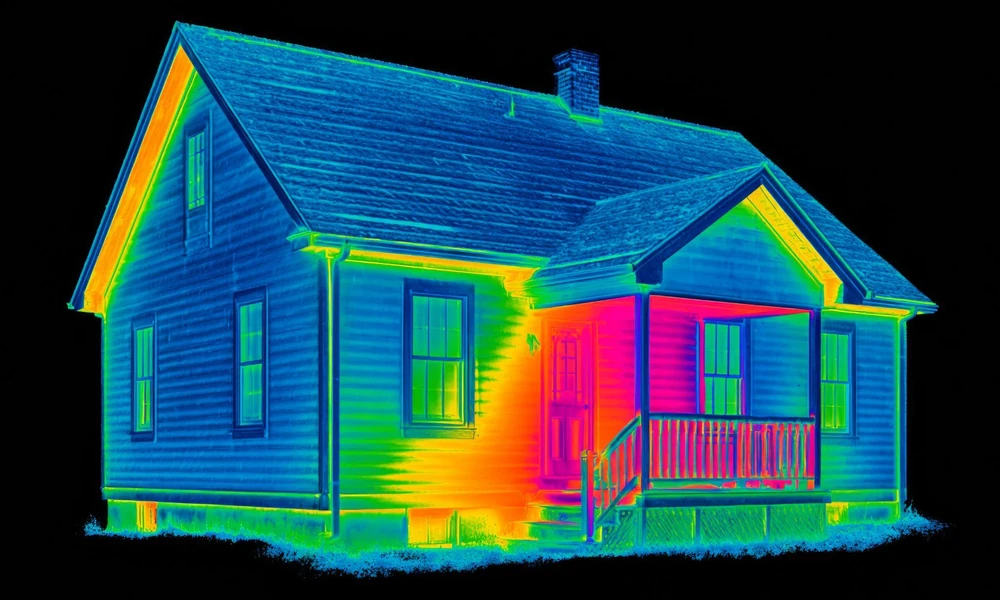
When fire safety engineers run fluid simulations to predict heat transfer and smoke movement, they rely heavily on computational fluid dynamics. However, behind every visually striking Computational Fluid Dynamics (CFD) 3D flow visualisation lies a mathematical structure that determines whether the simulation reflects reality or absolute fiction. That core framework is the computational grid, or mesh. Understanding why mesh quality dictates accuracy is crucial when evaluating any complex CFD thermal simulation.
Building the Blueprint: What Is Computational Meshing?
Before a solver calculates fluid velocity, buoyant forces, or heat distribution, it breaks a physical space down into thousands or millions of tiny geometric shapes called cells. Engineers refer to this network of cells as a mesh.
Think of a computational mesh as a digital net that captures physical changes across a room. If you throw a coarse net with giant holes at a fine target, you miss the vital details. In the same way, a poorly constructed mesh fails to capture sharp temperature gradients, localised turbulence, and thermal plumes.
Sharp Gradients and the Traps of Bad Geometry
Why does cell shape matter so much during CFD thermal analysis? Physics-based numerical solvers calculate fluid dynamics across neighbouring cell boundaries. When cells suffer from extreme distortion, poor orthogonal quality, or high skewness, mathematical errors compound rapidly:
- Non-Orthogonal Errors – When cell faces do not align perpendicular to the line connecting cell centres, solvers must calculate heavy artificial correction factors, introducing severe numerical diffusion into the solution.
- Aspect Ratio Distortions – Highly stretched cells fail to resolve omnidirectional heat transfer accurately, smearing high-temperature plumes into surrounding cool zones.
- Cell Jump Discontinuities – Sudden leaps from microscopic cells to massive volume cells create artificial resistance and fake pressure drops across critical boundary layers.
These geometric errors degrade accuracy and frequently cause simulation solvers to crash midway through execution.
Smoke, Heat, and High-Velocity Momentum
Thermal simulations rarely model stagnant air. In real-world fire safety engineering, such as enclosed underground car parks, high-velocity momentum mixes with buoyant hot gases. Consider the dynamic performance of a car park jet fan. These units discharge high-velocity air streams to entrain surrounding air, dilute carbon monoxide, and push smoke toward extraction points during a fire emergency.
Specific regions require targeted meshing strategies to ensure absolute simulation fidelity:
- Jet Fan Discharge – Demands fine local inflation layers and tight prismatic boundary refinement to accurately capture high-velocity shear stress, jet throw, and air entrainment without artificial damping.
- Thermal Plume Core – Requires uniform, non-skewed volumetric refinement with low growth rates to capture upward thermal buoyancy without prematurely smearing fire temperatures into ambient space.
- Obstructions and Beams – Uses conformal body-fitted meshing along geometric edges to prevent artificial pressure spikes and capture realistic boundary separation around structural ceiling beams.
- Far-Field Exhaust – Benefits from a smooth geometric transition from fine to coarse volume cells to prevent numerical wave reflections and maintain accurate overall mass balance across domain outlets.
If an engineer under-refines the discharge zone around a car park jet fan, the coarse grid will artificially diffuse the air jet. The simulation will incorrectly predict that the momentum dies prematurely, painting a dangerously inaccurate picture of smoke clearing capabilities.
Finding the Balance: Mesh Convergence and Efficiency
Engineers cannot simply set every cell in a massive building to a sub-millimetre scale. Running a 50-million-cell model requires immense computing power and days of processing time, which rapidly inflates project budgets.
Smart engineering relies on mesh refinement strategies and formal mesh independence studies. By placing high cell density precisely where rapid changes occur, such as near heat sources, physical obstructions, and high-velocity devices, engineers achieve high-fidelity predictions without wasting computing power. Validating that further mesh refinement no longer alters your temperature or velocity results confirms that your model has achieved true grid convergence.
The Bottom Line: Engineering Confidence Through Superior Meshes
Mesh quality serves as the ultimate backbone of reliable thermal fluid simulation. Skewed, coarse, or poorly transitioned computational grids produce misleading visual outputs that compromise life safety designs. By investing time into rigorous mesh generation, engineers ensure their safety predictions reflect true physical behaviour when it matters most.
Frequently Asked Questions
What causes numerical diffusion in CFD models?
Numerical diffusion occurs when coarse or skewed cells artificially smooth out sharp gradients, such as hot thermal plumes or concentrated velocity jets, making the simulation appear far calmer and more mixed than physical reality.
How do engineers test if a mesh is fine enough?
Engineers conduct a mesh independence study by running the same scenario across progressively finer meshes. Once key results, such as peak temperature or flow rate, stop changing significantly between runs, the mesh has achieved grid convergence.
Does a higher cell count always guarantee better accuracy?
Not necessarily. A high cell count with poor cell shapes, bad aspect ratios, or sudden size jumps can introduce more mathematical error than a lower-cell-count mesh with clean, orthogonal geometry.
Don’t leave your fire and smoke safety designs to chance or substandard simulations. Contact SHEVS IFT Consultants to secure rigorous, highly accurate CFD thermal modelling tailored to your project’s exact requirements!