
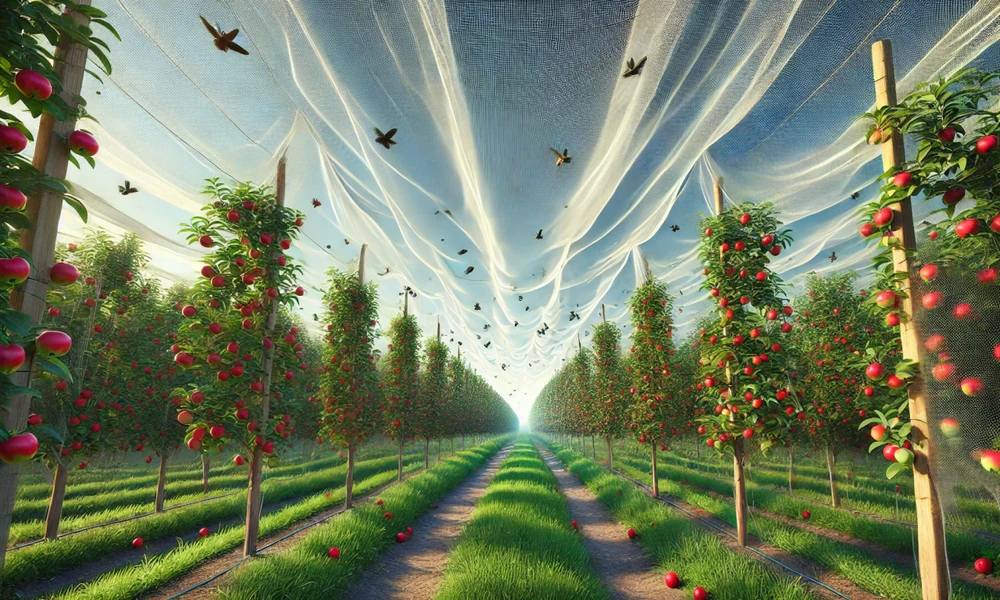
The monsoon season brings relief to Indian farmers after months of heat, but for apple growers in Himachal Pradesh and Pulwama, it also marks one of the most damage-prone stretches of the year. Waterlogging, fungal disease, and pest pressure all converge during the same weeks that pre-monsoon and monsoon hailstorms tend to strike ripening apple crops, and in these two belts, hail is consistently the threat growers plan their entire season around.
Anti-hail netting (AHN) has become one of the most dependable tools for managing this risk, and its role in monsoon-season apple farming is more consequential than many growers initially expect. Bird protection netting is sometimes used alongside AHN in these orchards, but hail remains the dominant threat driving netting investment across Himachal and Pulwama.
Why the Monsoon-to-Hail Window Is So Damaging for Apple
Hail activity around orchard land follows patterns tied to elevation and seasonal weather shifts. In Himachal Pradesh and Pulwama, the same weather systems that bring pre-monsoon and monsoon moisture also carry hail through the hills, often with little warning.
The timing couldn’t be worse. Apple crops that have spent months developing are most vulnerable in the weeks leading up to harvest, when even a short hailstorm can bruise, split, or scar fruit across an entire orchard. A single hail event moving through a Himachal apple belt or a Pulwama orchard can cause losses that show up immediately in grading and market value at the end of the season.
Post-monsoon surveys of orchard losses in these regions consistently rank hail damage among the leading causes of revenue reduction for apple growers, with losses sometimes running well beyond what growers expect until the fruit is graded for market.
The Quality and Market-Grade Problem That Comes With Hail
Hail damage on an apple crop isn’t just about fruit that falls or splits outright. Even fruit that survives a hailstorm often carries surface bruising and skin blemishes that push it out of premium grade and into lower-value categories.
In an export- or premium-market-oriented apple economy like Himachal’s, grade downgrades translate directly into lost income, even when the bulk of the crop is technically saved. For growers supplying processing units or export-grade markets with strict cosmetic standards, hail-scarred fruit is a serious compliance and revenue risk. A single storm can shift a season’s output from top grade to lower grade almost overnight.
What Anti-Hail Nets Do
The logic is straightforward. A physical barrier installed above the orchard canopy intercepts hail before it reaches the fruit. No direct impact means no bruising, no splitting, and no grade downgrade from surface damage.
Unlike reactive measures, an anti-hail net doesn’t depend on timing or warning systems. Once installed, the protection is passive, continuous, and requires no daily intervention through the hail-prone months.
HDPE (High-Density Polyethylene) netting in knitted configurations resists UV degradation, handles monsoon humidity without losing structural integrity, and is engineered specifically to absorb and disperse the impact energy of hailstones rather than simply blocking them. Quality agriculture nets, including AHN systems built for apple orchards, are typically specified by denier, GSM, and mesh density rather than mesh size alone, since the net needs to manage impact force, not just exclude a pest.
Installation Considerations in Himachal and Pulwama Orchards
A practical question for growers in these belts is whether to install AHN before or after the first pre-monsoon hail risk sets in. The answer depends on the fruit’s development stage.
For apple crops, nets installed before fruit set colours or softens provide continuous protection through the peak hail-risk window. Once fruit reaches that stage, hail risk and fruit vulnerability both rise sharply, so getting the net system in place ahead of that threshold is the practical guide most orchard managers follow in Himachal and Pulwama.
Orchard AHN systems are typically installed on a tensioned wire trellis structure raised above the canopy, sloped to allow rain to run off rather than pool, which reduces load on support posts during heavy monsoon rainfall. Support cables and anchor points also need to account for the additional wind loads that monsoon storms carry through hill terrain, since a sagging or loosely anchored net creates gaps that reduce hail protection exactly when it’s needed most.
Plant Protection Nets as a Broader System
While AHN is the primary layer of protection for apple growers in these belts, plant protection nets cover a range of functions, and orchards dealing with combined hail and monsoon pressures often benefit from a layered approach rather than a single-purpose installation.
Bird protection netting, insect exclusion mesh, and shade netting can all be added beneath or alongside an AHN structure depending on the orchard’s specific pest and climate pressures. In apple-growing regions outside Himachal and Pulwama, and in other fruit and grain crops across India, similar netting principles apply, though hail risk and product specification needs vary by region and crop, and demand for AHN specifically remains far more concentrated in the apple belts of Himachal Pradesh and Pulwama than elsewhere.
Choosing the Right AHN for the Application
The key specification decisions for anti-hail netting centre on denier, GSM, knit density, and UV life rating, rather than mesh size alone, since the net’s job is to absorb impact energy, not exclude a pest.
UV stabilisation is essential. Without adequate UV inhibitor loading, a net will begin to degrade within a season or two under Indian field conditions. A properly stabilised HDPE AHN system can remain effective for five years or more, making the cost per season considerably lower than it appears at the point of purchase. This is a significant factor for apple growers in Himachal and Pulwama weighing the upfront investment against a single hailstorm’s potential losses.
Getting the specification right from the beginning, matched to the orchard’s elevation, hail severity, and installation structure, is what determines whether the investment performs across multiple seasons.